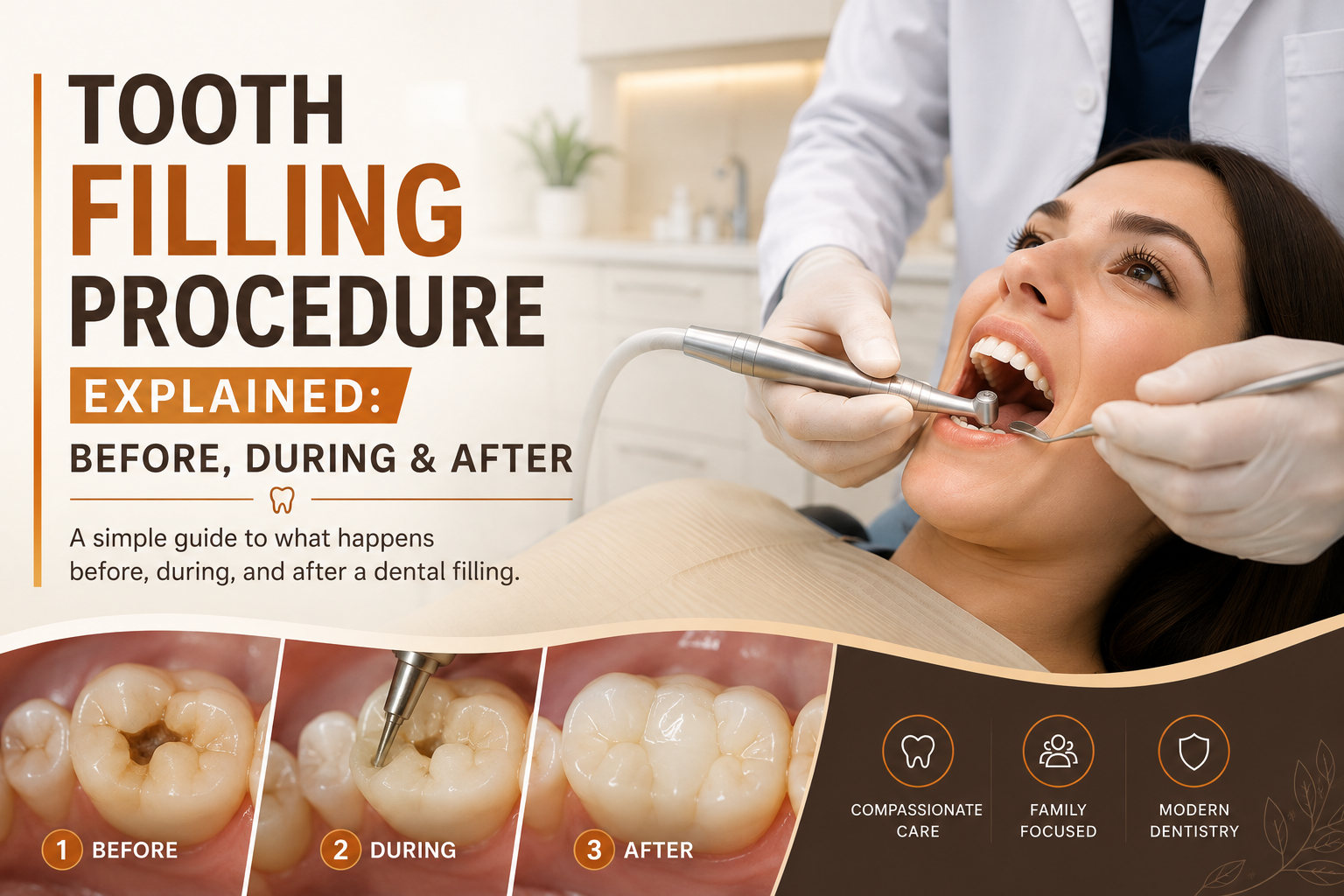
A tooth filling can usually restore a tooth affected by a cavity when the decay has not significantly damaged the dental pulp, helping preserve the tooth’s shape, strength, and function
If your dentist has told you that you need a filling, you probably have questions. A tooth filling is a routine restorative treatment that removes decay from a tooth and rebuilds the damaged area with a durable material, restoring the tooth’s shape, strength, and function. Most patients feel little to no pain during the procedure itself, since the area is numbed with local anesthetic before any decay is removed. What follows is a step-by-step look at what actually happens before, during, and after a filling appointment, so you know what to expect from the moment you sit down in the chair.
What Is a Tooth Filling?
A cavity forms when bacteria in the mouth produce acid that gradually breaks down the hard outer layer of a tooth, called enamel. Left untreated, that acid continues working its way deeper, past the enamel into the dentin underneath, and eventually toward the nerve at the center of the tooth. A filling stops that process by removing the decayed, softened tooth structure and replacing it with a restorative material that seals the area and rebuilds the tooth’s original shape.
Treating a cavity early matters. A small area of decay caught on a routine dental exam or X-ray can often be treated with a simple, single-visit filling. The longer decay is left alone, the more likely it is to reach the dental pulp, the soft tissue containing nerves and blood vessels inside the tooth, at which point a filling alone may no longer be enough.
How Do You Know If You Need a Filling?
Some of the more common signs of a cavity include:
– Sensitivity to hot or cold foods and drinks
– Discomfort or a twinge when eating something sweet
– A dull ache or toothache, especially when biting down
– Food consistently getting trapped in the same spot
– A visible dark spot, stain, or small hole on the tooth
– A rough or catching sensation when you run your tongue over the tooth
It’s worth noting that cavities do not always cause noticeable symptoms, particularly in the early stages. Many are first identified during a dental exam or on a routine X-ray, before the patient feels anything at all. Because of this, symptoms alone aren’t a reliable way to rule a cavity in or out. Regular checkups are what catch decay early, often before it requires anything more than a straightforward filling.
What Happens Before a Tooth Filling?
Before any decay is removed, your dentist takes a few steps to understand exactly what the tooth needs.
Dental examination. Your dentist visually and physically examines the tooth, checking for soft spots, discoloration, and how far the decay appears to extend.
X-rays. Dental X-rays can show decay between teeth or below the gumline that isn’t visible during a visual exam, and they help your dentist judge how close the decay is to the nerve.
Decay assessment. Based on the exam and X-rays, your dentist determines whether the decay can be treated with a filling, or whether it’s extensive enough to need a different approach.
Treatment discussion. Which filling material is recommended, and how the tooth will be prepared, often depends on several individual factors: where the tooth sits in your mouth, how large or deep the cavity is, how much healthy tooth structure remains, how visible the tooth is when you smile, and how much bite force it typically handles. Your dentist will walk you through what’s recommended for your specific situation before starting.
Tooth Filling Procedure: Step by Step
A typical filling appointment follows a consistent sequence, though the exact time and details can vary by tooth and case.
Step 1: Numbing the area. Your dentist applies a topical numbing gel to the gum, then injects a local anesthetic near the tooth. The injection itself may cause a brief pinch or pressure, but most patients report it’s far less uncomfortable than they expected. Within a few minutes, the area feels numb, tingly, or heavy. That numbness typically lasts a couple of hours after the appointment, sometimes longer depending on the anesthetic used and the location of the tooth.
Step 2: Removing the decay. Using a dental drill or, in some cases, other decay-removal instruments, your dentist carefully removes the softened, decayed portion of the tooth. Because the area is numb, this step is generally felt as pressure, vibration, or sound rather than pain. If you feel any sharp discomfort at any point, let your dentist know anesthesia can be topped up.
Step 3: Cleaning and preparing the tooth. Once the decay is removed, the space is cleaned to eliminate bacteria and debris, and the tooth surface is prepared so the filling material bonds properly.
Step 4: Placing the filling material. The chosen material is placed into the prepared space. Composite (tooth-colored) fillings are applied in layers and hardened with a curing light as they go. Amalgam fillings are packed into place and set as a single mass. The technique differs by material, but the goal is the same: fully rebuild the missing tooth structure.
Step 5: Shaping and adjusting the filling. Your dentist shapes the filling to match the natural contour of the tooth, then asks you to bite down so they can check your bite alignment. A filling that sits even slightly too high can feel uncomfortable once the numbness wears off, so this adjustment step matters.
Step 6: Polishing and final checking. The filling is polished smooth, and your dentist does a final check of the shape, bite, and margins before you’re finished.
Does Getting a Tooth Filling Hurt?
Most patients do not feel pain during the filling procedure itself, because the tooth and surrounding tissue are numbed with local anesthetic before any decay is removed. What you may notice instead is pressure, vibration, or the sound of the drill sensations that are common but not usually painful.
Experiences do vary. Some patients feel more anxious about the anesthetic injection than the filling itself; others are more sensitive to pressure and benefit from a bit of extra numbing agent. If you feel sharp pain, rather than pressure, at any point during treatment, tell your dentist it’s a signal that the area may need more anesthetic before continuing. No one should have to grit their teeth through a filling.
How Long Does a Tooth Filling Take?
A single, straightforward filling often takes somewhere in the range of 20 to 60 minutes, though this is a general estimate rather than a fixed number. Appointment length depends on several factors: how many teeth are being filled in one visit, how large or deep the decay is, which tooth is involved (back teeth can be more time-consuming to access), which filling material is used, and whether additional X-rays or steps are needed along the way. Your dentist can give you a more specific estimate once they’ve evaluated your tooth.
Types of Dental Fillings
Composite resin fillings are made from a tooth-colored resin material that bonds directly to the tooth. They’re a common choice for visible teeth because they blend in closely with natural tooth color, and they generally require removing less healthy tooth structure than some alternatives. Composite fillings can be more sensitive to placement technique and may not be the ideal choice for every situation, particularly very large fillings on back teeth that absorb heavy bite forces.
Amalgam fillings are a metal alloy that has been used in dentistry for well over a century. They’re known for durability, particularly in back teeth that handle significant chewing force, and they tend to be more tolerant of a slightly moist environment during placement. Their main drawback is appearance — the silver color is visible, which is why many patients today opt for composite on teeth that show when they smile.
Neither material is universally “better.” The right choice depends on the tooth’s location, the size of the cavity, cosmetic priorities, and your dentist’s clinical judgment.
What Happens After a Tooth Filling?
Immediately after your appointment, the treated area will likely still be numb, sometimes for a couple of hours. It’s common to notice mild sensitivity or soreness around the tooth and gum for a day or two, and your bite may feel slightly different at first as you get used to the new filling. Most patients return to normal eating, speaking, and daily activities the same day, once the numbness has fully worn off.
Can You Eat After a Filling?
It’s best to wait until the numbness has completely worn off before eating, since it’s easy to accidentally bite your cheek, lip, or tongue without realizing it while numb. Once feeling returns, you can generally eat normally.
If a composite filling was used, it’s typically hardened fully with a curing light during the appointment, so there’s usually no need to avoid chewing on that side right away. If an amalgam filling was placed, your dentist may recommend waiting a day before chewing directly on that tooth, since amalgam continues to fully harden over the following 24 hours. In the day or two after treatment, if the tooth feels sensitive, sticking to softer foods and avoiding extremes of hot or cold on that side can help.
Tooth Sensitivity After a Filling: Is It Normal?
Some sensitivity after a filling is common and usually temporary. It’s normal to notice mild sensitivity to cold, heat, pressure, or biting for a few days, and occasionally up to a couple of weeks, especially after a deeper filling.
That said, certain symptoms are worth having checked rather than waiting out:
– Pain that’s severe or getting worse instead of better
– Sensitivity that persists well beyond a couple of weeks
– Significant pain specifically when biting down
– Pain that comes on spontaneously, without anything triggering it
– Swelling in the gum or face near the treated tooth
– Fever
How long is “too long” can vary depending on how deep the original decay was and the individual tooth, so if something feels off, it’s always reasonable to call your dentist and ask rather than wait it out.
How Long Does a Dental Filling Last?
There’s no single fixed lifespan for a filling it depends on the material used, the size of the filling, which tooth it’s in, how much bite force that tooth handles, and factors within your control like oral hygiene, diet, and whether you grind or clench your teeth. Smaller fillings on teeth that don’t take heavy chewing forces tend to last longer than large fillings on molars. Regular dental exams help catch a filling that’s wearing down, cracking, or starting to leak before it turns into a bigger problem.
What If a Filling Falls Out?
If a filling comes out, contact your dentist as soon as you can rather than waiting for your next scheduled visit. In the meantime:
– Keep the area clean by gently rinsing with water
– Avoid chewing on that side of your mouth
– If you can find the filling, keep it in case your dentist wants to see it
– Watch for pain, swelling, or sensitivity, and mention any of these when you call
The space left behind is now exposed to bacteria and food again, so leaving it unfilled for too long increases the risk that new decay develops or that the tooth becomes more vulnerable to breaking.
Filling vs. Root Canal: What’s the Difference?
A filling treats decay while the tooth’s nerve and pulp are still healthy the goal is simply to remove the damaged structure and rebuild it. Root canal treatment becomes necessary when decay or damage has reached the dental pulp and caused irreversible inflammation or infection. In that case, a filling alone can’t resolve the underlying problem, because the source of the pain or infection is inside the tooth, not just on its surface.
Deep decay doesn’t always mean a root canal is inevitable, but it does mean your dentist will look closely at how close the decay sits to the nerve before deciding on treatment. If you’d like to understand this distinction in more depth, our [root canal treatment] page covers what that procedure involves.
Can Every Cavity Be Fixed With a Filling?
Not always. Whether a filling is sufficient depends on the size and depth of the decay, how much healthy tooth structure remains, whether the pulp has been affected, and whether the tooth itself is fractured. A small to moderate cavity is usually well suited to a filling. More extensive decay may call for a dental crown to protect a weakened tooth, root canal treatment if the pulp is involved, or, in cases where the tooth can’t be reasonably restored, extraction. Your dentist will explain which category your situation falls into and why.
How Can You Prevent Future Cavities?
– Brush twice a day with a fluoride toothpaste
– Clean between your teeth daily, with floss or another interdental tool
– Limit frequent snacking on sugary or acidic foods and drinks, which give bacteria more opportunities to produce acid
– Keep up with regular dental exams and cleanings, so early decay is caught while it’s still simple to treat
– Talk to your dentist about your individual cavity risk — some patients benefit from additional fluoride or sealants
Frequently Asked Questions About Tooth Fillings
Does getting a filling hurt?
Most patients do not feel pain during a filling because the area is numbed with local anesthetic beforehand. You may notice pressure or vibration during treatment, and mild soreness for a day or two afterward is common.
How long does a tooth filling take?
A single filling typically takes about 20 to 60 minutes, though this varies with the size of the cavity, the tooth’s location, and the material used.
How long does a filling last?
Filling lifespan depends on the material, size, location, and your oral habits. Regular checkups help your dentist catch a filling that needs attention before it fails.
Can I eat after getting a filling?
Wait until numbness fully wears off to avoid biting your cheek or tongue. After that, composite fillings can typically be chewed on right away, while amalgam may need about a day to fully harden.
How long will my tooth be numb after a filling?
Numbness commonly lasts one to a few hours, depending on the type and amount of anesthetic used and where the tooth is located.
Is sensitivity after a filling normal?
Mild, temporary sensitivity to hot, cold, or pressure is common for a few days after a filling. Pain that is severe, worsening, or lasting more than a couple of weeks should be evaluated by your dentist.
Can a cavity heal without a filling?
Very early enamel demineralization can sometimes be managed with fluoride and improved hygiene, but once true decay has formed a cavity, it will not repair itself and needs to be treated.
What happens if I don’t get a cavity filled?
Untreated decay tends to progress deeper into the tooth over time, which can eventually affect the nerve and require more involved treatment, such as a root canal or extraction.
Can a filling fall out?
Yes, fillings can loosen or come out, particularly older ones or those that have experienced repeated wear or new decay around the edges. Contact your dentist promptly if this happens.
Can a filling need to be replaced?
Fillings can wear down, crack, or develop a gap at the edges over time, which allows new decay to start underneath. Your dentist checks existing fillings at regular exams to catch this early.
Is a filling better than a root canal?
They treat different problems rather than being interchangeable options — a filling addresses decay that hasn’t reached the nerve, while a root canal treats a tooth where the nerve itself is inflamed or infected.
How do I know if my filling is too high?
A filling that sits too high on your bite often feels noticeable within a day, typically as discomfort when biting down or a tooth that feels “different” from the others. This is a quick, simple adjustment your dentist can make.
The Bottom Line
Getting a filling is one of the more routine and predictable procedures in general dentistry. Catching a cavity early usually means a straightforward, single-visit appointment, some mild soreness for a day or two, and a tooth that’s fully protected again. Sensitivity that lingers, worsens, or comes with swelling is the main thing to watch for and have checked rather than wait out. Because the right treatment depends on the individual tooth, the best next step if you suspect a cavity or if it’s been a while since your last exam is having it looked at.
If you’re in South Calgary, Heritage Pointe, De Winton, Okotoks, or a nearby community and think you may need a filling, the team at Heritage Pointe Dental is happy to take a look and walk you through what your tooth needs.