Reviewed by: Dr. Dharmanshu Boghara, Heritage Pointe Dental
Last updated: October 2026
If you’re researching Calgary dental implants, you likely want three things: a clear picture of the treatment, a realistic sense of cost, and a way to judge who should do the work. This guide covers all three.
The short answer: A dental implant is a titanium post placed in the jawbone to replace a missing tooth root, then topped with a crown. One independent 2026 estimate puts a complete single implant in Alberta at roughly $3,500 to $6,000, and treatment usually takes several months because the bone must heal around the post. Your own cost and timeline depend on an in-person assessment.
This is general information, not a diagnosis or treatment advice.
What Are Dental Implants and How Do They Work?
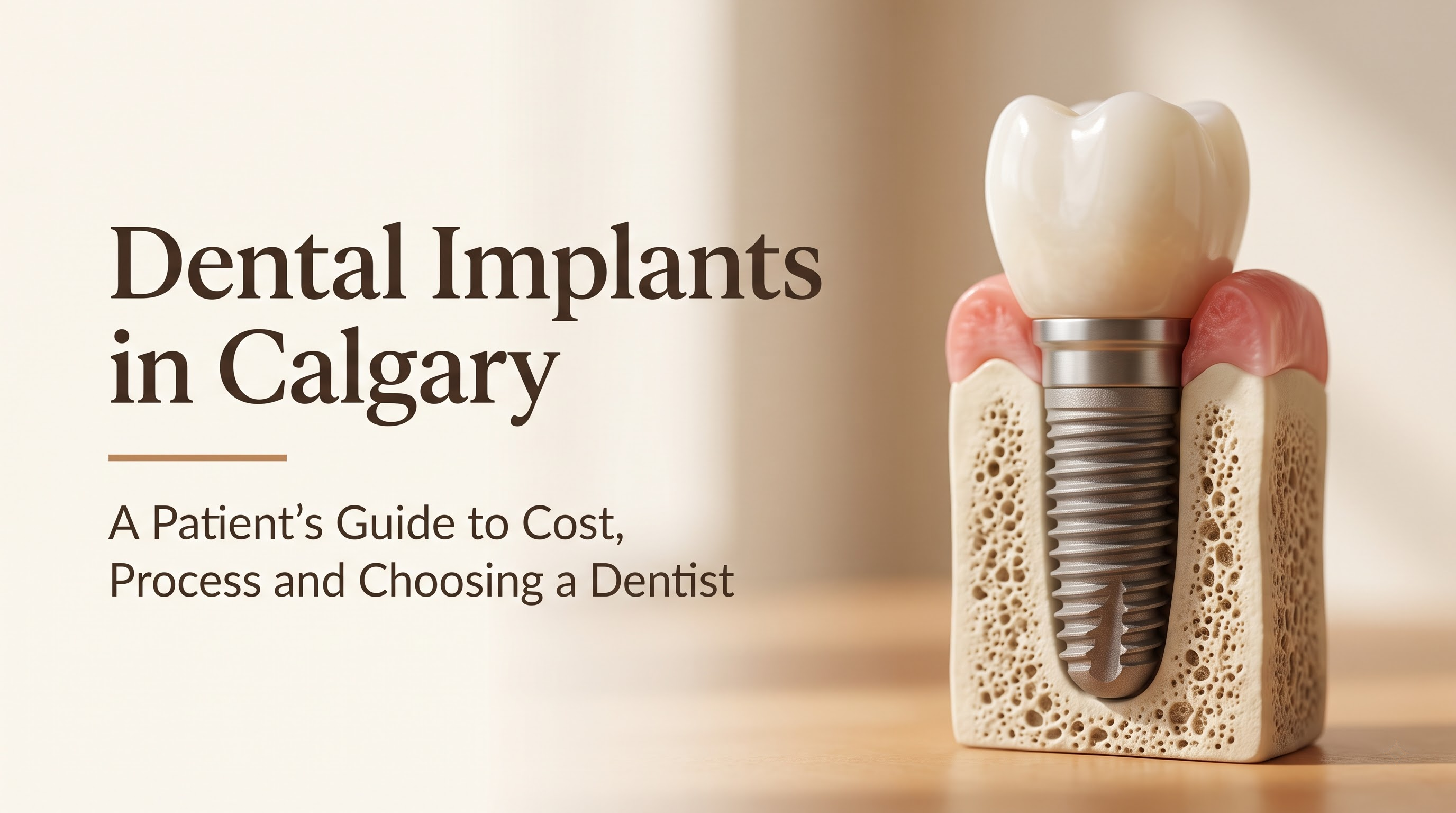
A dental implant replaces a missing tooth in three parts:
- Implant fixture: a titanium post placed in the jawbone that acts as an artificial root.
- Abutment: a small connector that attaches to the post.
- Crown: the tooth-shaped restoration you see, fixed to the abutment.
Over several months, the jawbone heals around the post in a process called osseointegration, which gives the crown a stable anchor. Implants can also support bridges and dentures, which is why they feature in both single-tooth and full-arch treatment. Unlike a traditional bridge, a single implant doesn’t rely on the neighbouring teeth for support.
Who Is a Good Candidate for Dental Implants?
Candidacy is an individual clinical decision. Dentists typically consider:
- Jawbone volume and density, since the post needs enough bone to hold it
- Gum health, because untreated gum disease can threaten an implant
- Overall health and medical history, including conditions that affect healing
- Medications, including some that influence bone or healing
- Smoking, which is linked to poorer healing and a higher risk of implant problems
Having one of these factors doesn’t automatically rule out treatment, and having none doesn’t guarantee suitability. If bone has shrunk after tooth loss, a bone graft may be recommended first. An exam and X-rays are what determine whether an implant is a sound option for you.
How Much Do Dental Implants Cost in Calgary?
Direct answer: An independent 2026 estimate based on provincial fee guides places a complete single implant in Alberta (fixture, abutment and crown) at about $3,500 to $6,000 CAD (Real Dental Costs, Dental Implant Cost by Province, reviewed June 2026). That is an estimate, not a Calgary clinic quote, and it excludes preparatory work such as extractions, bone grafting or sedation.
What makes up the total
| Cost component | What it covers | Often missing from advertised prices? |
|---|---|---|
| Exam and imaging | Assessment, X-rays or scans, treatment planning | Sometimes |
| Implant fixture and placement | The titanium post and the surgical visit | Rarely |
| Abutment | Connector between post and crown | Often |
| Crown | The visible tooth, including lab fees | Often |
| Preparatory care | Extractions, bone grafting, gum treatment | Almost always |
| Sedation | Anything beyond local freezing, if used | Often |
Why quotes differ
A low advertised implant price may cover only the post, so comparing it with a quote that includes the crown isn’t like for like. Totals also rise with the number of teeth, the need for bone grafting, the materials chosen and the complexity of the case. Multiple-implant and full-arch treatments are priced very differently from a single tooth and need their own estimate.
Insurance and payment
Private plans vary widely, and some cover part of the crown or surgical portion, so ask for a pre-treatment estimate before you commit. The Canadian Dental Care Plan excludes dental implants and implant-related procedures, as Manulife’s CDCP summary explains. For payment questions, see Heritage Pointe Dental’s insurance and payment information.
Whichever clinic you choose, ask for an itemized written estimate after your assessment.
The Dental Implant Process: What to Expect
Steps vary with each case, but treatment generally follows this order:
- Consultation and assessment. The dentist reviews your medical history and examines your teeth and gums. X-rays of the jaw and teeth show the bone and nearby roots.
- Treatment planning. The plan covers timing, the type of restoration and any preparatory work.
- Preparatory procedures, if needed. These may include extractions or a bone graft. In some bone-graft cases, a dentist may refer you to a specialist.
- Implant placement. After numbing, the dentist makes a small incision in the gum, places the titanium implant in the jawbone and stitches the gum.
- Healing. The implant fuses with the bone over several months.
- Abutment and crown. Once healed, the abutment is attached and the final crown is secured.
- Follow-up. A review visit confirms the tooth is comfortable and your bite is correct.
How long does treatment take?
Usually months, not weeks, largely because of healing time. Grafting or staged treatment lengthens it. Ask for a timeline as part of your treatment plan.
Does Getting a Dental Implant Hurt?
Placement is normally done with local anaesthetic, so you shouldn’t feel pain during the procedure, though you may feel pressure. Soreness, swelling or bruising afterwards are common and vary by person and case. Contact your dentist if pain worsens instead of easing, or if you notice fever, persistent swelling or bleeding.
Recovery, Aftercare and How Long Implants Last
Follow your dentist’s post-surgery instructions, keep the area clean and avoid smoking, which can interfere with healing. Once healed, care for an implant like a natural tooth: brush twice daily, floss daily and keep regular checkups and cleanings so your dentist can monitor the gums and bite around it.
How long do implants last? Many last for years with good care, but no one can promise a lifespan. The post may stay stable while the crown wears and needs replacing. Gum inflammation around an implant (peri-implant disease) is a known cause of problems, which is why maintenance matters. Risks include infection, an implant that doesn’t fuse with the bone and, rarely, nerve or sinus complications depending on location.
Dental Implants vs. Bridges vs. Dentures
| Dental implant | Dental bridge | Denture | |||
|---|---|---|---|---|---|
| How it’s held | Post in the jawbone | Crowns on neighbouring teeth | Rests on gums, or clips to implants | ||
| Neighbouring teeth altered? | No | Usually yes | No | ||
| Stimulates the jawbone? | Yes, where the post sits | No | No, unless implant-supported | ||
| Typical treatment time | Several months | Often a few visits | Varies | ||
| Typical upfront cost | Higher | Lower | Lower | ||
| Often suited to | Enough bone and healthy gums | Healthy teeth either side of a gap | Several or all teeth missing |
A dentist can explain which option fits your mouth, goals and budget. You can read more about dental bridges and dental crowns.
How to Choose a Dentist for Dental Implants in Calgary
Look beyond price:
- Registration: Confirm the dentist is registered with the Alberta Dental Association and College, the provincial regulator.
- Training and experience: Ask about implant-specific training and how often they place implants.
- Who does what: Ask whether one dentist handles planning, surgery and the crown, and when complex surgery is referred to a specialist.
- Planning: Look for a documented assessment with imaging before any quote.
- Transparency: Ask for an itemized estimate that shows every component.
- Aftercare: Ask how follow-up and long-term maintenance work, and what happens if a complication arises.
Questions to ask at your consultation
- Am I a suitable candidate, and what could change that?
- Do I need a bone graft or other preparation?
- What does your quote include and exclude?
- What is the expected timeline?
- What are the risks given my health history?
- What are my alternatives?
Why Consider Heritage Pointe Dental?
Heritage Pointe Dental is at Unit 400, 412 Pine Creek Road, Heritage Pointe, AB T1S 4J9, and serves South Calgary communities including Walden, Legacy, Cranston, Seton, Auburn Bay and Mahogany, as well as De Winton and Okotoks. Implant care at the clinic is provided by general dentists, and a consultation includes an exam and X-rays to assess candidacy before surgery is scheduled. If a case needs specialist input, such as some bone-graft situations, you may be referred. Learn more on our dental implants page.
The office is open Monday 9 a.m. to 4 p.m. and Tuesday to Thursday 8:30 a.m. to 4:30 p.m.
Frequently Asked Questions
How much does a single dental implant cost in Calgary?
One independent 2026 estimate puts a complete single implant in Alberta at about $3,500 to $6,000, including the post, abutment and crown. Extractions, grafting and sedation are extra. Only an assessment and written estimate give your actual cost.
How long does the dental implant process take?
Usually several months, mostly healing time while the bone fuses with the post. Bone grafting or other preparation adds time. Your dentist can give a timeline for your case.
Are dental implants covered by insurance?
It depends on your private plan, and many cover only part of the treatment. The Canadian Dental Care Plan excludes implants. Ask for a pre-treatment estimate to confirm what your plan pays.
Is implant surgery painful?
The procedure is done with local anaesthetic, so you should feel pressure rather than pain. Soreness and swelling afterwards are common. Call your dentist if pain worsens or you notice fever.
Can anyone get a dental implant?
Not everyone. Suitability depends on bone, gum health, overall health, medications and smoking. A dentist decides after an exam and X-rays, and may suggest alternatives such as a bridge.
Next step
If you’re weighing implants, a consultation gives you a plan and an itemized estimate based on your own mouth. Call 403-873-2289 or book an appointment.