
October 29, 2026 • 8 min read
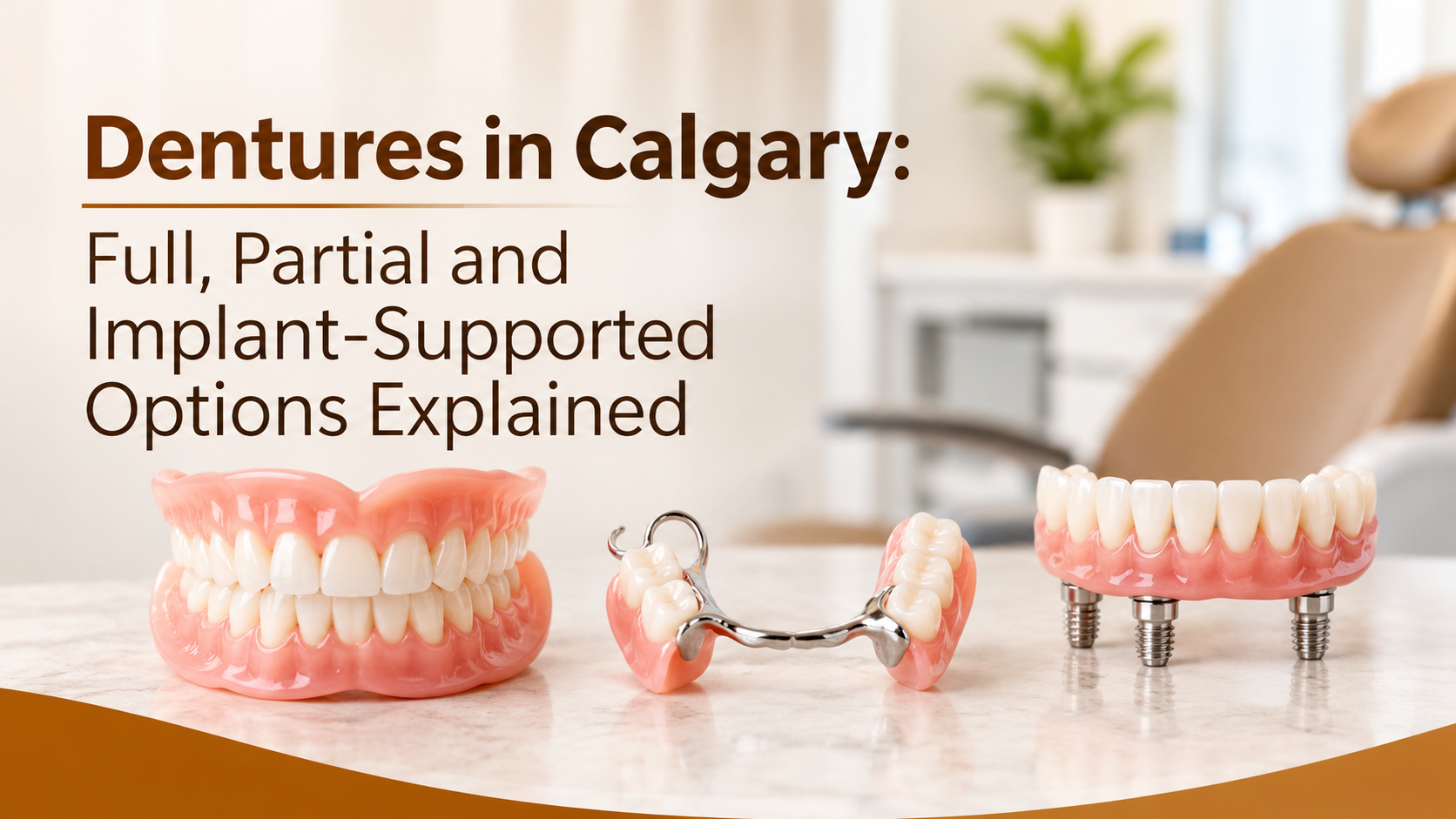
Dentures in Calgary come in three main types: full (complete) dentures, partial dentures and implant-supported dentures. The right one depends on how many teeth you’re missing, the health of your remaining teeth, gums and jawbone, your budget, and how secure you want the denture to feel. Only an exam can show which suits you.
Quick facts
- Full dentures replace every tooth in an upper or lower arch. Partial dentures replace some teeth and attach to the natural teeth around them.
- Implant-supported dentures snap onto dental implants for extra stability, but they cost more and need enough healthy bone.
- One independent estimate puts a complete denture in Alberta at about $1,325 per arch. Actual quotes vary.
- The Canadian Dental Care Plan (CDCP) covers complete dentures and, with preauthorization, partial dentures, but not implant-supported dentures.
This guide is general information, not a diagnosis. Your dentist or denturist will recommend a plan after examining your mouth.
What Are Dentures?
Dentures are removable replacement teeth, usually made from acrylic and sometimes with a metal framework, that help you chew, speak and smile when natural teeth are missing. Depending on the type, they rest on your gums, attach to remaining teeth or connect to dental implants. Unlike dental bridges, which are fixed in place, most dentures come out for cleaning.
Types of Dentures Compared
| Type | Replaces | How it stays in | Often suited to | Worth knowing |
|---|---|---|---|---|
| Complete (conventional) denture | All teeth in an arch | Rests on the gums; suction, sometimes adhesive | No teeth left in that arch, after the gums have healed | Made after extractions heal; fit changes as gums and bone reshape |
| Immediate denture | All teeth in an arch, placed the day teeth are removed | Same as complete | People who don’t want to be without teeth while healing | Usually needs relining or replacing as the gums shrink |
| Partial denture | One or more missing teeth | Clasps or attachments on natural teeth | Healthy remaining teeth and gums | Metal-framework (cast) partials are slimmer and often more durable than acrylic ones, but cost more |
| Implant-supported denture (overdenture) | All teeth in an arch | Snaps onto two or more dental implants | People who want more stability and have enough bone | Needs surgery and healing time; not covered by the CDCP |
Fixed full-arch implant options also exist, where the teeth are screwed onto implants and aren’t taken out at home. They’re a more extensive treatment, so ask your dentist whether you’re a candidate. Our dental implants guide explains the implant side in more detail.
Which Option Is Right for You?
Dentists and denturists typically weigh:
- How many teeth are missing, and where
- The health of remaining teeth and gums, since partial dentures clasp onto them
- Jawbone volume, which affects whether implants are possible
- Your general health, medications and whether you smoke
- Your budget and insurance
- Your priorities, such as stability when eating or speaking
Research offers one useful benchmark. A 2002 consensus statement from McGill University experts recommended a two-implant overdenture as the first-choice treatment for a fully toothless lower jaw, because conventional lower dentures can feel unstable (McGill consensus statement). That doesn’t make it right for everyone, but it’s worth asking about if your lower denture moves.
How Much Do Dentures Cost in Calgary?
Direct answer: Independent estimates put a complete denture in Alberta at about $1,325 per arch and a cast partial denture at about $1,150. These are estimates, not published fee-guide amounts. A 2026 national guide shows wider ranges of $1,500 to $4,000 per arch for complete dentures and $800 to $2,500 for partials, depending on materials and provider. Implant-supported dentures cost considerably more because they include implants and surgery.
Prices are usually quoted per arch, so a full set for the upper and lower jaw costs roughly double.
What changes your total:
- Type and materials, such as acrylic or a metal framework
- Extractions, gum treatment or bone work needed first
- Immediate dentures, which are more complex and usually cost more
- Adjustments, relines and repairs afterward
- The provider, since dentists and denturists set fees separately
Insurance and the CDCP: The CDCP covers complete dentures, and partial dentures require preauthorization (Government of Canada). Dentures supported by implants, and implant-related procedures, aren’t covered (Government of Canada). Private plans vary, so ask for a written estimate before treatment. See our insurance and payment information.
The Denture Process: What to Expect
Steps differ by type, but conventional dentures generally follow this order:
- Exam and assessment. Your provider reviews your health history and examines your teeth, gums and jaw, often with X-rays.
- Treatment plan. This covers the type of denture, any extractions or gum treatment, and the cost.
- Impressions and measurements. Moulds of your gums and a record of how your jaws meet guide the lab.
- Try-in. You check the fit, bite and appearance of a trial denture, and changes are made before the final one is made.
- Fitting and adjustments. The finished denture is fitted and adjusted for comfort.
- Follow-up. New dentures often need small adjustments as you get used to them.
Conventional dentures usually take several appointments, and teeth that need removing generally have to heal first. Immediate dentures are placed the day teeth are removed.
Getting Used to Dentures and Caring for Them
New dentures can feel bulky, and sore spots, extra saliva and changes in speech or chewing are common at first. Soft foods and small bites help, and a follow-up visit can fix pressure points.
To keep dentures in good shape:
- Clean them daily with a denture brush and a denture cleanser, skipping regular toothpaste, which can scratch
- Remove them at night so your gums can rest, and keep them moist when out
- Clean your gums and any natural teeth, and keep up regular dental checkups
- Handle them over a sink with water or a towel in case you drop them
Gums and bone change over time, so dentures often need relining, adjusting or replacing after several years. Ask your dentist how often to have yours checked.
Denture Clinic, Denturist or Dentist?
In Alberta, dentures can be provided by dentists and by regulated denturists, a separate profession. Denturists can make complete dentures directly. Procedures such as extractions and implant placement are done by dentists or dental specialists, so if you need those first, or want implant support, a dental clinic can coordinate the whole plan. Whoever you choose, confirm they’re registered with their Alberta regulator.
Questions to Ask Before You Choose a Provider
- Which denture type do you recommend for me, and why?
- What does the quote include, such as try-ins, adjustments and a reline?
- Do I need extractions or other treatment first?
- How long will the process take?
- Can you submit a CDCP preauthorization or insurance estimate for me?
- What happens if the denture doesn’t fit well?
Frequently Asked Questions
How much do dentures cost in Calgary?
Independent estimates put a complete denture in Alberta at about $1,325 per arch and a cast partial at about $1,150, but quotes vary with materials, extractions and provider. Ask for an itemized written estimate.
How long does it take to get dentures?
Conventional dentures usually take several appointments, after any extractions have healed. Immediate dentures are fitted the day teeth are removed.
Are dentures covered by insurance in Alberta?
The CDCP covers complete dentures and, with preauthorization, partial dentures, but not implant-supported ones. Private plan coverage varies, so check yours before treatment.
Are implant-supported dentures better than regular dentures?
They typically feel more stable, and research supports two-implant overdentures for the lower jaw, but they need surgery, enough bone and a higher budget. Your dentist can tell you whether you’re a candidate.
How long do dentures last?
It varies. Gums and bone change over time, so dentures often need relining, adjustment or replacement after several years. Regular checkups help catch problems early.
Next step
If you’re weighing your options, an exam is the way to get a recommendation and itemized estimate for your own mouth. Call Heritage Pointe Dental at 403-873-2289 or book an appointment.
Sources and Further Reading
- Government of Canada: Canadian Dental Care Plan, services covered
- Government of Canada: CDCP partial denture preauthorization
- The McGill consensus statement on overdentures (Gerodontology, 2002)
Cost figures are estimates and change each year. Last updated: October 2026.