
June 29, 2026 • 8 min read
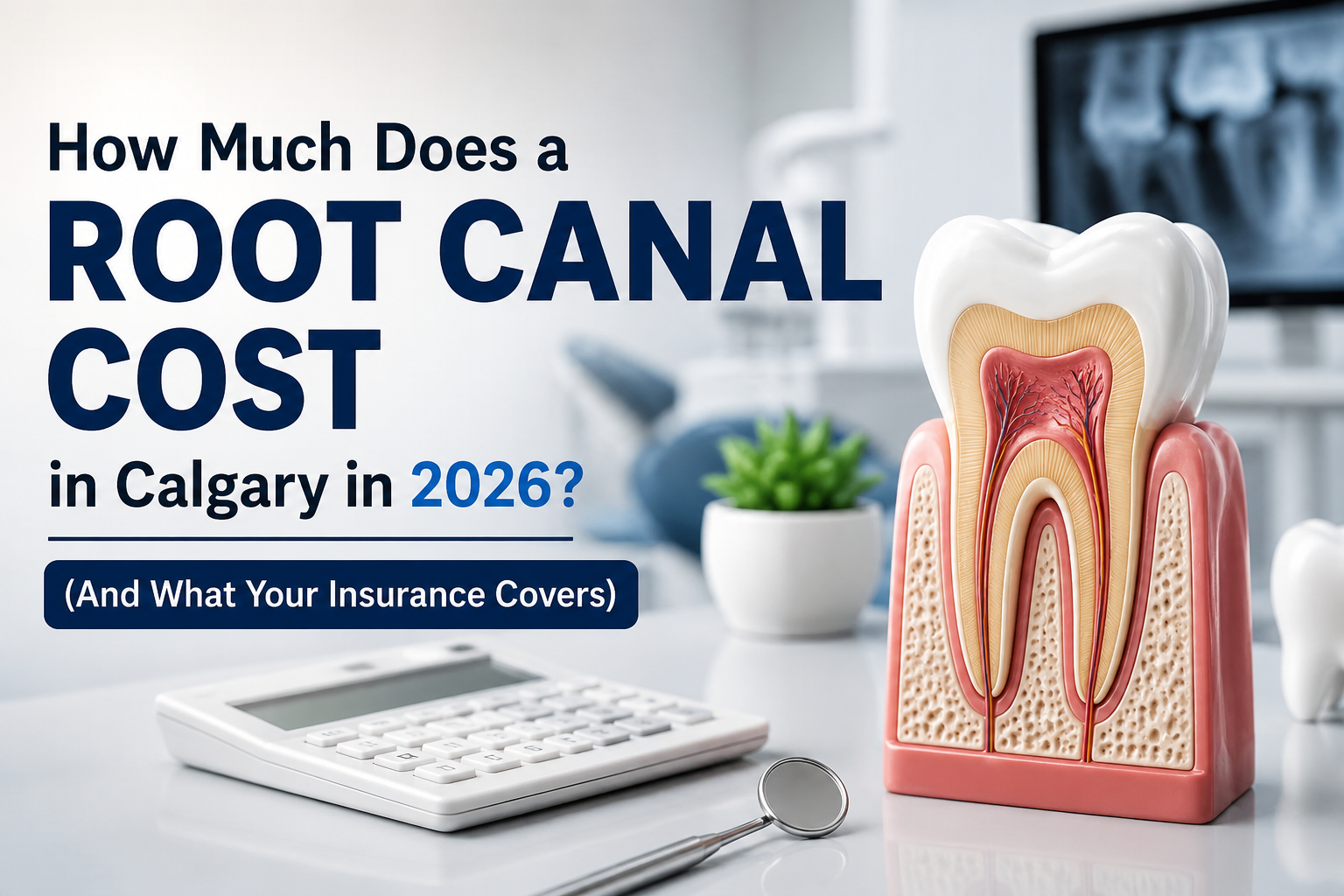
Based on the 2026 Alberta Dental Association (ADA) Suggested Fee Guide, a root canal in Calgary typically costs between $795 and $1,355 for the procedure alone, depending on the number of roots/canals in the tooth. Front teeth with a single canal sit at the lower end of that range, while molars with two or three canals land at the higher end. These figures cover the root canal itself; the filling or crown needed to restore the tooth afterward is billed separately.
Introduction
A molar root canal in Calgary can cost more than a dental crown, yet most patients walk into the consultation with no idea what number to expect. That uncertainty is often more stressful than the procedure itself.
If you have been told you need a root canal, or you are simply trying to plan ahead, understanding the real numbers behind root canal cost in Calgary will help you make a confident, informed decision about your treatment.
This guide breaks down what root canals typically cost in 2026, what dental insurance and the Canada Dental Care Plan (CDCP) will and will not pay for, and where the affordable options actually are.
Average Root Canal Cost in Calgary
Dentists in Alberta generally use the ADA fee guide as a reference point, though every clinic sets its own fees.
According to the 2026 guide, the suggested fees for uncomplicated permanent root canals are:
| Procedure | Suggested 2026 Fee |
| Root canal, 1 canal (front tooth) | $795.45 |
| Root canal, 2 canals (premolar) | $1,158.35 |
| Root canal, 3 canals (molar) | $1,354.65 |
Molars can sometimes have four canals, which pushes the fee higher still. Keep in mind that these are suggested, not mandatory, fees.
Some dentists charge slightly above or below the guide, so the number on your treatment plan may differ from what you read online. Always ask your clinic for a written estimate before treatment begins.
What Is a Root Canal?
A root canal, formally called root canal therapy, treats a tooth whose internal pulp and nerve tissue has become damaged or infected. The dentist removes that tissue, disinfects the hollow space inside the tooth, and seals it with an inert filling material. The goal is straightforward: eliminate the infection and pain while keeping your natural tooth in your mouth, rather than extracting it.
Why Might You Need a Root Canal?
Several situations can lead a dentist to recommend root canal therapy:
- Deep decay that has reached the nerve of the tooth.
- A cracked or fractured tooth that exposes the pulp to bacteria
- Repeated dental procedures on the same tooth, which can eventually irritate the pulp
- Trauma, even an old injury, that damages the nerve without an obvious break in the tooth
- An abscess or visible swelling near the gum line, often a sign of advanced infection
If you are experiencing lingering sensitivity to heat or cold, pain when chewing, or a tooth that has darkened in colour, it is worth having it assessed before the problem worsens.
What Factors Affect the Cost of a Root Canal?
The fee on your treatment plan reflects more than just the appointment itself. Several variables shape the final number.
- Number of canals. This is the single biggest driver of cost. Front teeth (incisors and canines) usually have one canal. Premolars often have two. Molars, which do the heaviest chewing work, can have three or even four. More canals mean more time, more materials, and a higher fee.
- Tooth location. Molars sit at the back of the mouth and are harder to access, which adds complexity regardless of canal count.
- Severity of infection. A tooth with a large abscess or significant bone involvement may need extra appointments, additional imaging, or a longer course of treatment than a straightforward case.
- General dentist versus endodontist. Most root canals are completed by general dentists. However, particularly complex cases, retreatments, or teeth with unusual canal anatomy are often referred to an endodontist, a specialist in this exact procedure. Specialist fees tend to run higher than general dentist fees, partly because of their advanced training and the equipment they use, such as dental microscopes and 3D imaging.
- Restoration afterward. The root canal fee does not include the filling or crown placed afterward to protect and rebuild the tooth. That cost is separate and depends on the material chosen.
What Does Insurance Cover for Root Canal Treatment?
Most private dental insurance plans in Canada classify root canal therapy as a major or endodontic service, and the majority of plans do offer coverage.
That said, the details vary considerably between providers and even between plans from the same insurer.
A few things worth confirming with your provider before treatment:
- Coverage percentage. Many plans reimburse 50 to 80 percent of the cost for endodontic treatment, though this is not universal.
- Annual maximums. Most plans cap how much they will pay out per calendar year, which matters if you need a root canal and a crown in the same year.
- Waiting periods. Newer policies sometimes delay coverage for major services for the first several months.
Fee guide alignment. Some insurers reimburse based on an older provincial fee guide. If your dentist charges current 2026 rates, you may be responsible for the difference. - Because every policy reads differently, the most reliable step is to ask your dental office for a pre-treatment estimate.
- Fee guide alignment. Some insurers reimburse based on an older provincial fee guide. If your dentist charges current 2026 rates, you may be responsible for the difference.
This document is sent to your insurer before treatment starts and outlines exactly what they will pay, so there are no surprises afterward.
Does the Canada Dental Care Plan (CDCP) Cover Root Canals?
The CDCP, the federal program for Canadians without private dental insurance, does cover standard root canal treatment. Coverage applies to incisors, canines, premolars, and first and second molars without requiring preauthorization. Third molars, retreatments, and procedures like apicoectomies require preauthorization, and retreatment is limited to once per tooth in a lifetime.
How much you pay out of pocket depends on your adjusted family net income:
- Under $70,000: no co-payment; the CDCP covers the full established fee
- $70,000 to $79,999: a 40 percent co-payment
- $80,000 to $89,999: a 60 percent co-payment
- $90,000 and above: not eligible for the CDCP
One important detail patients often miss: the CDCP uses its own federal fee schedule, which is not identical to the Alberta Dental Association’s fee guide.
If your dentist’s fees are higher than the CDCP rate, you are responsible for that gap, even if your income places you in the no-co-payment tier. Confirming your dentist participates in the CDCP, and asking what that gap might look like, is worth doing before you book.
Root Canal Cost Without Insurance
If you do not have private insurance and do not qualify for the CDCP, you will be paying the full fee directly.
Based on the 2026 ADA fee guide, that means roughly $795 for a single-canal root canal up to around $1,355 for a three-canal molar, before any crown or filling is added.
A few ways to manage this if you are paying out of pocket:
- Ask for a written treatment plan that separates the root canal fee from the restoration fee, so you can see the full picture and budget accordingly.
- Inquire about payment plans. Many Calgary dental clinics offer in-house financing or partner with third-party providers to spread the cost over several months.
- Check whether you qualify for the CDCP. Even a partial co-payment is generally less than paying the entire fee yourself.
- Ask about dental school clinics. The University of Alberta’s dental clinic, while not in Calgary itself, offers reduced-fee treatment performed by supervised students and may be worth the drive for some patients.
Root Canal Cost vs Tooth Extraction Cost
When a tooth is badly damaged, patients sometimes ask whether it would simply be cheaper to have it pulled instead.
In the short term, yes. A straightforward extraction costs around $175 under the 2026 ADA fee guide, far less than a root canal. The comparison changes, though, once you factor in tooth replacement.
An extracted tooth leaves a gap that can shift your bite, affect chewing, and lead to bone loss in the jaw over time.
Replacing that gap with a dental implant in Alberta commonly runs anywhere from roughly $2,000 to $6,000 or more per tooth, once the surgical placement and crown are both included, and that is before considering a bone graft if one is needed.
A bridge is sometimes more affordable than an implant but still typically costs more than the root canal would have.
In most cases, a root canal followed by a crown costs less overall than an extraction followed by an implant or bridge, while also preserving your natural tooth and the bone that supports it.
Root Canal and Crown Cost: What Should You Expect?
Many root canal-treated teeth, especially molars, need a crown afterward. Without the full tooth structure intact, a heavily treated tooth can be more prone to fracture under everyday chewing pressure.
Based on 2026 ADA fee guide figures, a porcelain-fused-to-metal crown carries a suggested fee of approximately $1,073, plus laboratory charges that vary by case.
Combined with a molar root canal, the total for both procedures together commonly lands somewhere between $2,400 and $2,800, though the exact number depends on the number of canals and the crown material selected.
Not every root canal needs a crown. Front teeth with smaller access openings can sometimes be restored with a simple filling. Your dentist will let you know during your consultation whether your particular tooth needs the added protection of a crown.
Is a Root Canal Worth the Cost?
For most patients, yes. A root canal resolves the infection causing pain, preserves the tooth’s root and surrounding bone, and keeps your bite and facial structure intact. Compared to the long-term cost and complexity of an extraction followed by a replacement tooth, a root canal is often the more economical choice when the numbers are added up over time.
There are limited situations where extraction makes more sense, such as a tooth with extensive structural damage that cannot reasonably support a crown, or a tooth with poor long-term prognosis even after treatment.
This is a clinical judgment best made with your dentist after an examination and X-ray.
Ways to Make Root Canal Treatment More Affordable
A few practical options can ease the financial side of treatment:
- Get a pre-treatment estimate sent to your insurer before booking, so you know your exact out-of-pocket cost in advance.
- Ask about in-house payment plans, which many Calgary clinics offer for treatment over a few hundred dollars.
Check CDCP eligibility if you do not currently have private insurance. - Time major dental work around your insurance year if you are close to your annual maximum, since some plans renew benefits each calendar year.
How Long Does a Root Canal Last?
A root canal treated tooth can last for decades, often for the rest of a patient’s life, provided it is properly restored and cared for afterward.
The two factors that matter most for longevity are getting the appropriate restoration (a crown, where needed) promptly after treatment, and continuing with regular checkups so any new decay around the tooth is caught early.
A root canal-treated tooth no longer has live nerve tissue inside it, so it will not develop the kind of pain that originally signalled a problem. Routine dental exams remain the best way to monitor it going forward.
Frequently Asked Questions
How much does a root canal cost in Calgary in 2026?
Based on the 2026 ADA fee guide, expect roughly $795 for a single-canal tooth up to $1,355 for a three-canal molar, not including the filling or crown afterward.
Does dental insurance cover root canals?
Most private plans cover root canal therapy as a major or endodontic service, typically at 50 to 80 percent, though annual maximums and fee schedules vary by provider.
How much does a molar root canal cost?
Molars typically have two to three canals, putting the suggested 2026 fee between roughly $1,158 and $1,355, before any crown is added.
Is a root canal cheaper than extraction and implant?
Yes, in most cases. While extraction alone is less expensive upfront, replacing the tooth with an implant typically costs several thousand dollars more than a root canal and crown combined.
How much does a root canal and crown cost together?
For a molar, the combined total commonly falls between $2,400 and $2,800, depending on the number of canals and crown material chosen.
Can I get a root canal without insurance?
Yes. You will pay the full clinic fee directly, though some Calgary dentists offer payment plans, and you may qualify for partial or full coverage under the CDCP depending on your income.
How many visits does a root canal require?
Most uncomplicated root canals are completed in one or two appointments. More complex cases, particularly molars with significant infection, may require an additional visit.
How long does a root canal last?
With a proper restoration and regular dental checkups, a root canal-treated tooth commonly lasts for decades, often a lifetime.
Conclusion
Root canal costs in Calgary vary mainly based on which tooth is involved and how many canals it has, with 2026 fees typically ranging from around $795 to $1,355 for the procedure itself.
Whether you have private insurance, qualify for the CDCP, or are paying out of pocket, the most useful step you can take is asking for a clear, written estimate before treatment begins. A root canal that saves your natural tooth is, in nearly every case, a sound long-term investment in both your comfort and your wallet.
If you are looking for affordable root canal in Calgary and are not sure what your next step should be, our team at Heritage Pointe Dental can walk you through your options, your estimated costs, and what your specific insurance plan covers, before you commit to treatment.
About the Author
Dr. Dharmanshu Boghara, DDS
General Dentist at Heritage Pointe Dental
Dr. Boghara has over 15 years of experience in restorative and cosmetic dentistry, specializing in front tooth fillings, dental implants, and smile restorations. Based in Calgary since 2014, he is committed to compassionate, patient-focused care and staying at the forefront of dental advancements.