
May 25, 2026 • 10 min read
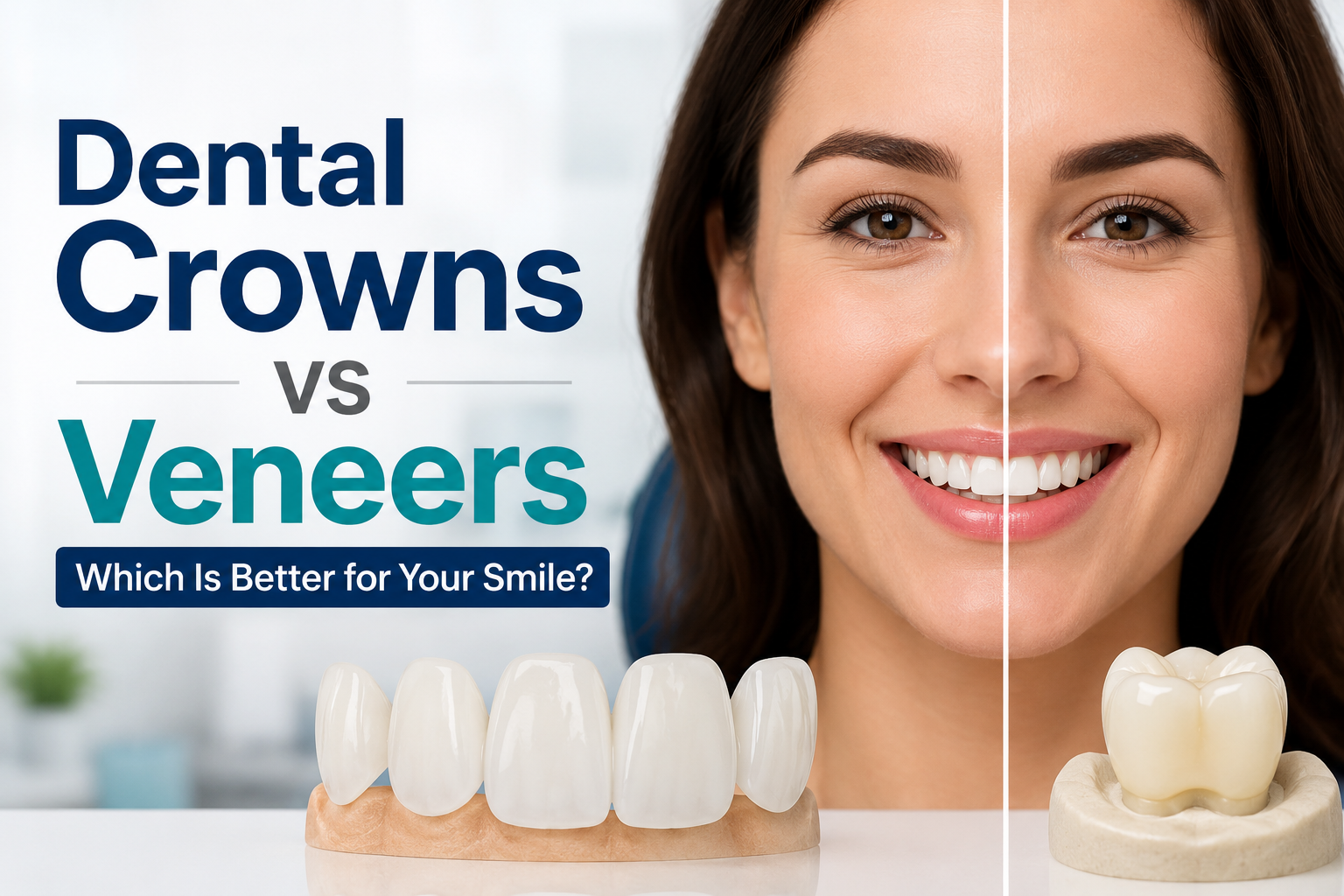
Dental Veneers are thin porcelain shells bonded to the front surface of healthy teeth, primarily for cosmetic improvement. Dental Crowns are full-tooth prosthetic caps that restore damaged, weak, or heavily decayed teeth. If your tooth is structurally sound but aesthetically flawed, a veneer is likely the right fit. If it’s broken, root-canal treated, or significantly decayed, a crown is the better option.
Introduction
Dental crowns vs veneers is one of the most common comparisons patients research when trying to improve their smile. Your dentist just mentioned crowns or veneers, and now you’re on Google trying to figure out what that actually means for your tooth, your wallet, and how your smile will look afterward. You should definitely know what you’re agreeing to before you sit in the chair. The difference comes down to one thing: how much structural damage your tooth has. Dental Veneers are for teeth that look bad but are fundamentally healthy. Dental Crowns are for teeth that are damaged, weakened, or at risk.
This article explains how to tell which situation you’re in, and what to ask your dentist before you decide.
What Are Dental Veneers?
A veneer is a thin, custom-made shell that is permanently bonded to the front-facing surface of a tooth. They are usually made of resin or porcelain. It’s designed to fix the way a tooth looks without altering its underlying structure significantly. Veneers are one of the most popular elective dental procedures among adults who want a complete smile change without orthodontics or more invasive treatment.
How Veneers Work
Getting veneers typically spans two appointments:
- Your dentist removes a thin layer of enamel from the front of the tooth, usually around 0.5mm for the veneer. This step is irreversible; you’ll need a veneer on that tooth for life.
- An impression or digital scan is taken and sent to a dental lab where your custom veneer is fabricated. A temporary veneer protects the tooth in the meantime.
- At the second appointment, the permanent veneer is bonded with dental cement and hardened with a UV light.
Types of Veneers
Porcelain veneers are the gold standard. They are durable, stain-resistant, and mimic the light-reflecting properties of natural enamel very well. Composite resin veneers are applied directly to the tooth surface and shaped by your dentist in a single visit. They are more affordable and don’t require as much enamel removal, but they’re less durable and more prone to staining over time. No-prep or minimal-prep veneers (sometimes marketed under brand names like Lumineers) require little to no enamel removal. They work for specific cases but aren’t suitable for everyone, and they can look slightly bulky if the tooth isn’t prepped at all.
Common Reasons Patients Choose Veneers
- Teeth that are permanently stained and don’t respond to whitening (tetracycline staining, fluorosis)
- Minor chips or cracks that are cosmetic rather than structural
- Slightly uneven or misshapen teeth
- Small gaps between front teeth
- Teeth that appear too short
What Are Dental Crowns?
A dental crown is a cap that fits over the entire visible portion of the tooth, from the biting surface down to the gum line. Unlike a veneer, which only covers the front, a crown surrounds the tooth on all sides.
Crowns serve both restorative and protective functions. They rebuild the tooth’s shape and size while shielding the remaining natural structure from further damage.
How Dental Crowns Work
Crown placement also typically requires two visits: The dentist grinds the tooth down on all sides to create space for the crown, significantly more removal than a veneer requires. Any decay is removed first. If there isn’t enough tooth structure left, your dentist may build it up with a filling material or post.
A digital scan or mould is taken and sent to a lab to fabricate the custom crown. A temporary crown protects the tooth while you wait. At the second appointment, the permanent crown is cemented into place and your bite is checked and adjusted.
Types of Dental Crowns
- All-porcelain (all-ceramic) crowns offer the most natural appearance and are commonly used for front teeth. They don’t contain metal, which eliminates the dark line at the gum line that older crowns sometimes show.
- Porcelain-fused-to-metal (PFM) crowns have a metal substructure with a porcelain overlay. They’re strong, but the metal margin can become visible at the gum line over time, particularly as gums recede with age.
- Full metal crowns (gold or other alloys) are extremely durable and require less tooth removal than porcelain options, but their colour makes them obvious. They’re typically used for back molars where aesthetics matter less.
- Zirconia crowns are a newer option that combines the strength of metal with a tooth-coloured appearance. They’ve become increasingly popular and are considered a strong choice for both front and back teeth.
When Dental Crowns Are Recommended
-
- A tooth has a very large cavity that a filling can’t adequately restore
- A tooth has been treated with a root canal (root-canaled teeth become brittle and need protection)
- A tooth is cracked or fractured in a way that compromises its integrity
- A tooth is severely worn down from grinding
- As the final restoration on a dental implant
- After significant tooth structure has been lost
Dental Crowns vs Veneers: Key Differences
| Feature | Veneers | Crowns |
|---|---|---|
| Coverage | Front surface only | Entire tooth |
| Thickness | ~0.5–1mm | ~2mm |
| Enamel Removed | Minimal | Significant |
| Primary Purpose | Cosmetic | Restorative and protective |
| Best For | Healthy teeth with visible flaws | Damaged, weak, or decayed teeth |
| Insurance Coverage | Rarely covered | Often partially covered |
Which Option Looks More Natural?
Both look very natural when done well. Veneers have a slight edge for front teeth. They are thinner, cover less surface area, and don’t risk showing a dark gum-line margin over time the way older PFM crowns can. Modern all-ceramic and zirconia crowns largely eliminate that issue and also produce excellent results.
Which Lasts Longer: Crowns or Veneers?
Crowns generally last longer. A well-placed crown can last 10–20 years, and with good home care and regular dental visits, sometimes longer. Veneers typically have a lifespan of 10–15 years for porcelain, and 5–7 years for composite.
Dental Crowns vs Veneers Cost Comparison
In Calgary and across Canada, the cost of both treatments varies depending on the material used, the complexity of the case, and the dental practice.
- Veneers typically range from $900 to $2,500 per tooth for porcelain. Composite veneers are cheaper, often $250–$1,500 per tooth, but don’t last as long. Veneers are almost always considered cosmetic and are not covered by dental insurance.
- Crowns typically range from $1,000 to $2,000+ per tooth depending on material. Because crowns are usually placed for functional reasons (decay, fracture, root canal), dental insurance will often cover a portion of the cost — commonly 50%, subject to your plan’s annual maximum and waiting periods.
A crown may cost more per tooth on paper but end up cheaper after insurance. A veneer may cost less upfront but come entirely out of pocket. Always check your coverage before committing to a treatment plan.
Pros and Cons of Veneers
Pros:
- Less enamel removal than crowns, preserving more of the natural tooth
- Very natural-looking results, especially for front teeth
- No visible gum-line margin over time (compared to PFM crowns)
Stain-resistant (porcelain)
Cons:
- Irreversible — once enamel is removed, you need a veneer on that tooth permanently
- Rarely covered by insurance
- Only covers the front surface; the rest of the tooth can still decay
- Not suitable for structurally compromised teeth
- Composite veneers have a shorter lifespan and stain more easily
Pros and Cons of Dental Crowns
Pros:
- Full tooth protection — covers all surfaces, reducing decay risk on the treated tooth
- Stronger and more durable for teeth that are damaged or weakened
- Often partially covered by dental insurance
- Can restore both function and appearance simultaneously
Cons:
- Requires removal of significantly more tooth structure
- PFM crowns may show a grey line at the gumline as gums recede
- The prepared tooth may be more sensitive to temperature initially
- More involved procedure compared to veneers
Are Veneers or Crowns Better for Front Teeth?
If the tooth is healthy but has surface-level issues — staining, a small chip, a gap — a veneer is usually the better call. Less tooth structure is removed, and the results look very natural.
If the tooth has been root-canaled, cracked deeply, or lost significant structure, a crown is necessary regardless of aesthetics.
Not sure which applies to your tooth?
Book a quick consultation with Heritage Pointe Dental in Calgary, we’ll tell you exactly what you’re looking at
How to Know Whether You Need Veneers or Crowns
Here’s a general framework to follow if you are confused:
You’re likely a veneer candidate if:
- Your teeth are structurally intact with no major decay or fractures
- Your concern is primarily cosmetic (colour, shape, minor chips)
- You have enough enamel remaining for bonding
- You don’t have a heavy grinding habit (or are willing to wear a nightguard)
You’re likely a crown candidate if:
- The tooth has had a root canal
- There’s a crack that goes beyond the enamel
- A large filling has failed and there isn’t enough natural tooth left for another
- The tooth is visibly broken or severely worn
- Your dentist has identified structural weakness
When in doubt, ask your dentist to explain why they’re recommending one over the other.
A good clinician will walk you through the clinical reasoning.
Alternatives to Crowns and Veneers
Depending on what you’re trying to fix, other options may be worth discussing:
- Dental bonding uses composite resin applied and shaped directly onto the tooth. It’s the least invasive option and can fix minor chips, gaps, and staining in a single visit. It doesn’t last as long as veneers or crowns but involves no enamel removal and is significantly cheaper.
- Teeth whitening handles staining without any tooth alteration. Professional in-office whitening is effective for extrinsic staining, though it won’t change the colour of existing crowns or veneers.
- Orthodontics or Invisalign is the right solution if spacing or alignment is the main concern rather than the tooth surface itself.
- Dental implants replace a tooth entirely and may be the better long-term option if the natural tooth is beyond saving.
Frequently Asked Questions
Are veneers cheaper than crowns?
Per tooth, veneers can cost slightly less than crowns — but crowns are often partially covered by insurance, whereas veneers almost never are, which can flip the out-of-pocket comparison.
Do crowns look more natural than veneers?
Both can look very natural; all-ceramic and zirconia crowns look excellent. However, veneers tend to have a slight aesthetic advantage for front teeth in patients with healthy underlying teeth, as they’re thinner and involve less alteration of the tooth.
Which hurts more: veneers or crowns?
Neither procedure is performed without local anesthesia, so neither should be painful during treatment. Crowns involve more tooth reduction, so some patients experience more post-procedure sensitivity, but this typically settles within a few days.
Can veneers turn into crowns later?
Yes. If a tooth that has a veneer later becomes damaged or decayed, a crown may be required, your dentist would remove the veneer and prepare the tooth for a crown.
Are crowns stronger than veneers?
Yes. Crowns cover the entire tooth and are made to withstand significant bite force. Veneers are bonded to the front surface only and are not designed for structural reinforcement.
Which option removes more tooth enamel?
Crowns require considerably more enamel removal — on all surfaces of the tooth. Veneers remove only a thin layer from the front surface, typically around 0.5mm.
Can you get veneers on damaged teeth?
Not usually. A tooth needs sufficient healthy enamel for a veneer to bond to and must be structurally sound. A damaged or weakened tooth generally requires a crown instead.
Conclusion
The dental crowns vs veneers debate doesn’t have a universal winner, it has a right answer for each individual tooth. Veneers are excellent for cosmetic improvements on healthy teeth. Crowns are the appropriate choice when a tooth needs structural restoration or protection. At Heritage Pointe Dental, we assess each tooth on its own merits and discuss all your options clearly before recommending a treatment plan. If you are in Calgary and considering either procedure, book a consultation with our team. We’ll take a close look at what’s actually going on with your teeth and give you a straight answer on what will serve you best, for both function and appearance.
About the Author
Dr. Dharmanshu Boghara, DDS
General Dentist at Heritage Pointe Dental
Dr. Boghara has over 15 years of experience in restorative and cosmetic dentistry, specializing in front tooth fillings, dental implants, and smile restorations. Based in Calgary since 2014, he is committed to compassionate, patient-focused care and staying at the forefront of dental advancements.