
February 26, 2026 • 8 min read
🦷 Quick Summary
If a tooth filling falls out, the exposed tooth becomes vulnerable to bacteria, sensitivity, and further damage. To protect it, avoid chewing on that side, keep the area clean, and use temporary dental cement if needed. Most importantly, schedule a dental appointment as soon as possible so the filling can be replaced before decay, infection, or tooth fracture develops.
Introduction
A tooth filling restores the structure and function of a tooth affected by decay or a minor fracture. Modern restorative materials—such as composite resin, amalgam, or ceramic—are engineered for durability, but no restoration is permanent. Over time, mechanical stress, secondary decay, or adhesive breakdown may compromise retention.
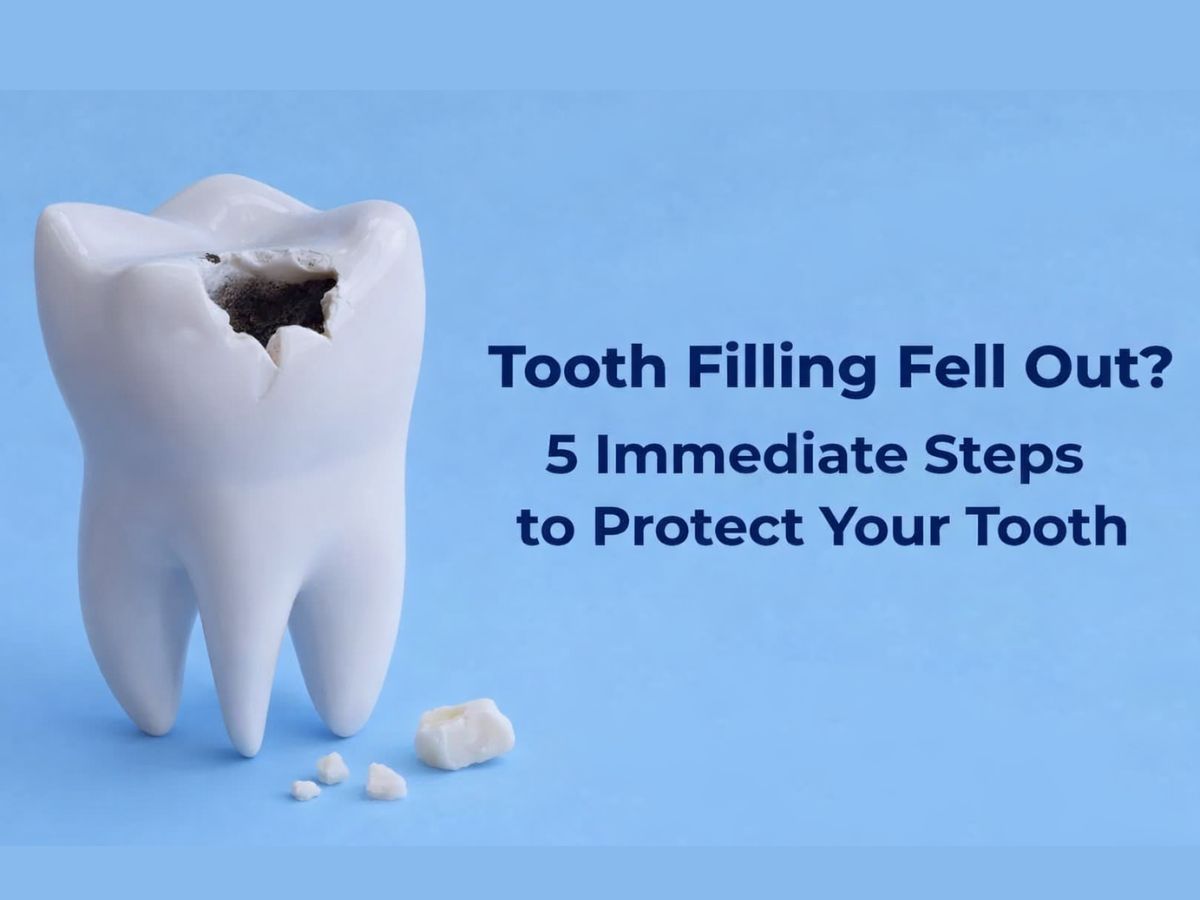
When a tooth filling dislodges, the underlying tooth structure becomes exposed and vulnerable.Although a lost restoration may not always cause immediate pain, it should never be ignored. Prompt action reduces the risk of bacterial contamination, structural fracture, and pulpal complications.
This article outlines why a filling may fall out, five immediate steps to protect the affected tooth, and when professional evaluation is necessary.
Why a Tooth Filling Can Fall Out
Several biological and mechanical factors contribute to restoration failure. Understanding these causes helps clarify why timely replacement is essential.
- Recurrent (secondary) Decay
Caries may develop at the margin of an existing restoration. As decay progresses, it weakens the bond between the filling material and the tooth structure, leading to dislodgement. - Material Fatigue
Restorations are subjected to continuous occlusal forces during chewing. Over time, repeated stress can cause microfractures or debonding, particularly in large restorations. - Adhesive Breakdown
Composite fillings rely on micromechanical bonding to enamel and dentin. Degradation of the adhesive interface may compromise retention. - Bruxism or Heavy Occlusion
Chronic clenching or grinding increases force concentration on restorations, especially in posterior teeth. - Trauma or Biting Hard Objects
Chewing ice, hard candy, or non-food objects can dislodge a restoration abruptly. - Age of the Restoration
Older fillings may loosen simply due to wear and long-term structural changes.
A front tooth cavity filling may be particularly vulnerable if it is thin or placed in a high-stress area.
5 Immediate Steps to Take If a Tooth Filling Falls Out
When a filling becomes dislodged, early intervention is critical.
The following steps help minimize complications until professional care is obtained.
-
Step 1 – Don’t Ignore the Missing Filling
Even if the tooth feels comfortable, the exposed dentin and enamel are no longer protected. Open margins allow bacteria and food debris to accumulate.
The risk of sensitivity, infection, or fracture increases with time.
Exposed dentin contains microscopic tubules that connect to the pulp.
Thermal stimuli or sweet foods may trigger sensitivity due to fluid movement within these tubules.
Ignoring the issue increases the likelihood of deeper bacterial penetration.
-
Step 2 – Protect the Tooth Right Away
If possible, retrieve the dislodged filling.
While it cannot typically be permanently reinserted at home, bringing it to the dental office may assist in evaluation.
Temporary dental cement, available at pharmacies, may provide short-term coverage.
These materials are not substitutes for professional treatment but may reduce sensitivity and contamination until definitive care is provided.
Avoid inserting random materials into the cavity. Improvised solutions increase the risk of irritation or infection.
-
Step 3 – Avoid Chewing on That Side
The remaining tooth structure may be weakened.
Chewing on the affected side increases the risk of fracture or cusp breakage, particularly in molars.
If the lost restoration involves a front tooth filling, avoid biting directly into hard foods.
Instead, cut food into smaller pieces and use the opposite side for chewing.
A fractured tooth may require more extensive treatment, including crown placement or endodontic therapy.
-
Step 4 – Keep the Area Clean (Gently)
Maintaining oral hygiene is essential to prevent bacterial accumulation.
- Rinse with warm salt water to reduce debris and inflammation.
- Brush gently using a soft-bristle toothbrush.
- Avoid aggressive flossing that may irritate exposed dentin.
Cleanliness helps reduce the risk of secondary infection while awaiting definitive restoration.
-
Step 5 – Book a Dental Appointment Promptly
A lost restoration should be evaluated as soon as possible. Delaying care increases the risk of:
- Recurrent decay progression
- Pulpal inflammation
- Tooth fracture
- Need for more invasive procedures
Patients searching for a tooth filling near me should prioritize timely consultation rather than waiting for discomfort to develop.
Is a Lost Tooth Filling a Dental Emergency?
A missing restoration is not always an immediate emergency, but it can become one. Urgent evaluation is recommended if you experience:
- Severe or throbbing pain
- Swelling of the gums or face
- Sensitivity that lingers after stimulus removal
- Signs of infection (fever, foul taste, discharge)
These symptoms may indicate pulpal involvement or abscess formation. In such cases, immediate care is warranted.If pain is minimal and no swelling is present, the situation remains time-sensitive but not necessarily emergent.
Prompt scheduling within a few days is advisable.
What Happens If You Wait Too Long to Replace a Filling?
Delaying the replacement of a lost tooth filling can lead to progressive structural and biological complications. Even if the tooth does not feel painful initially, the exposed area is vulnerable to bacterial invasion, mechanical stress, and temperature sensitivity.
The longer the tooth remains unprotected, the greater the likelihood that a minor restorative issue becomes a more complex dental problem.
- Progression of Decay
When a filling falls out, the prepared cavity underneath becomes exposed.
This area often contains microscopic irregularities where bacteria can easily accumulate. Without the protective seal of the restoration, food particles and plaque collect inside the cavity.
Because dentin is softer than enamel, decay can spread more rapidly once the protective layer is lost.
What may have originally been a small, localized cavity can expand deeper into the tooth structure in a relatively short period of time.
The deeper the decay progresses, the more tooth structure must be removed during treatment. Early replacement may only require a new filling, but advanced decay may require more extensive intervention.
- Pulpal Inflammation
The pulp contains nerves and blood vessels that keep the tooth alive.
If bacteria penetrate deeply enough, the pulp may become inflamed (a condition known as pulpitis). In early stages, inflammation may be reversible. However, if bacterial contamination continues unchecked, the pulp can become irreversibly damaged.
At that point, symptoms may include spontaneous throbbing pain, pain that lingers after hot or cold exposure, or discomfort that worsens at night. When the pulp becomes infected, root canal therapy is typically required to remove the infected tissue and preserve the tooth structure.
Replacing a lost filling early significantly reduces the risk of needing endodontic treatment.
- Structural Fracture
Fillings help restore structural integrity to the tooth. When a restoration falls out, the remaining tooth structure may already be compromised.Chewing forces are not evenly distributed across weakened enamel and dentin.
Without the internal support provided by the filling, cusps (the pointed parts of molars and premolars) may fracture under normal biting pressure. A small fracture may require a crown for reinforcement.
A severe crack extending below the gum line may render the tooth non-restorable.
The longer the cavity remains unprotected, the higher the likelihood of structural damage.
- Increased Treatment Complexity
One of the most practical consequences of waiting too long is that treatment often becomes more complex.
What may have been resolved with a simple replacement filling can escalate into:
- A larger restoration
- A crown to reinforce a weakened structure
- Root canal therapy if the pulp is involved
- In rare cases, extraction if the damage is extensive
Early intervention preserves natural tooth structure and minimizes both procedural complexity and financial burden. Timely care is almost always more conservative than delayed treatment.
5. Gum Irritation and Food Impaction
Open cavities create irregular surfaces where food can become trapped. Repeated food impaction irritates the surrounding gum tissue and may cause localized inflammation.Patients sometimes report discomfort when flossing or notice bleeding around the affected tooth.
Chronic irritation can contribute to localized gum problems and make the area more difficult to clean effectively.
Restoring the tooth promptly eliminates these plaque-retentive areas and helps maintain periodontal health.
Timely restoration preserves remaining tooth structure and reduces long-term cost and morbidity.
What NOT to Do If a Filling Falls Out
Certain actions may worsen the condition:
- Do not use household adhesives.
- Do not insert sharp objects into the cavity.
- Do not delay care because pain is absent.
- Do not continue chewing normally on the affected side.
- Do not assume the tooth will “self-seal.”
Improper self-management increases the likelihood of complications.
Frequently Asked Questions
- Can I eat if my tooth filling fell out?
Yes, but avoid chewing on the affected side. Choose soft foods and avoid extreme temperatures.
- Can I put the filling back myself?
No. Reinsertion requires proper isolation and bonding techniques. Temporary dental cement may provide short-term coverage, but definitive treatment must be performed by a dental professional.
- Will I need a root canal if my filling falls out?
Not necessarily. If addressed promptly, many lost restorations can be replaced without further intervention. Root canal therapy is only required if the pulp becomes irreversibly inflamed or infected.
- How long can I wait before seeing a dentist?
Evaluation within a few days is advisable. Waiting several weeks significantly increases the risk of complications.
- Does a lost filling always hurt?
No. Some patients experience minimal or no discomfort initially. However, absence of pain does not indicate absence of risk.
Conclusion
A dislodged tooth filling exposes the underlying tooth structure to mechanical stress and bacterial contamination. While immediate discomfort may vary, prompt protective steps and timely professional evaluation are essential to prevent escalation. Early intervention often allows straightforward restoration, whereas delayed care may require more complex treatment.
For patients seeking tooth filling Calgary services, Heritage Pointe Dental provides comprehensive restorative evaluation using evidence-based diagnostic protocols. In addition to routine restorative procedures, Heritage Pointe Dental offers preventive, cosmetic, and advanced therapeutic services under one roof.
Reach out to us for all your dental treatment needs today.
About the Author
Dr. Dharmanshu Boghara, DDS
General Dentist at Heritage Pointe Dental
Dr. Boghara has over 15 years of experience in restorative and cosmetic dentistry, specializing in front tooth fillings, dental implants, and smile restorations. Based in Calgary since 2014, he is committed to compassionate, patient-focused care and staying at the forefront of dental advancements.
Published on: